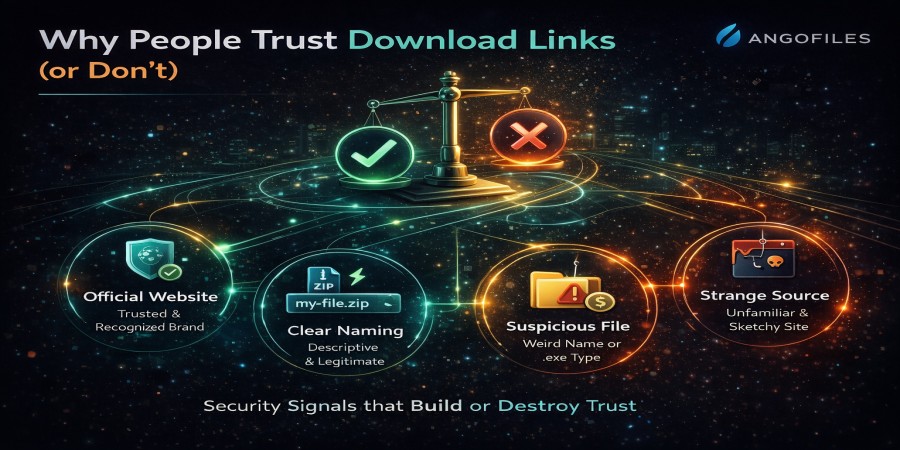
Why People Trust Download Links (or Don’t)
Apr 20, 2026 05:27 AM
Leandro Neto
Why People Trust Download Links (or Don’t)
Every time a user encounters a download link, a silent evaluation begins. In less than a second, the brain asks: Is this safe? Is this worth it? Should I click?
This decision is not random. It is shaped by psychology, past experiences, visual cues, and perceived risk. In the world of file sharing, trust is the difference between high download rates and complete abandonment.
Understanding why people trust or distrust download links is essential if you want to build a reliable system, grow your audience, and increase conversions.
Trust Is a Risk Calculation
At its core, trust is a calculation between risk and reward.
Before clicking, users subconsciously evaluate:
- What am I getting?
- What could go wrong?
- How likely is something bad to happen?
If the perceived reward (value of the file) is higher than the perceived risk (security concerns), the user proceeds. If not, they hesitate or leave.
This is why even valuable files fail when trust signals are weak.
The Psychology of Fear in Downloads
Downloading a file is one of the few online actions that feels “invasive.” Unlike reading a webpage, a download interacts directly with the user’s device.
This triggers concerns such as:
- Malware or viruses
- Data theft
- Device damage
- Hidden software installations
Even users with little technical knowledge are aware of these risks. As a result, they become cautious by default.
Trust must overcome this built-in fear.
First Impressions: The Visual Layer of Trust
Before users read anything, they judge what they see.
A download page that looks:
- Clean
- Organized
- Professional
creates immediate confidence.
On the other hand, pages that appear:
- Cluttered
- Filled with ads
- Poorly designed
trigger suspicion.
This reaction is automatic. Users associate visual quality with credibility, even if the content itself is the same.
The Role of File Names in Trust
File names act as micro-promises. They tell users what to expect.
A good file name:
- Is clear and descriptive
- Matches the user’s intent
- Looks intentional and professional
For example:
file_new(2).zip→ unclear, low trustComplete YouTube Growth Guide 2026.pdf→ clear, high trust
When users understand exactly what they are downloading, uncertainty decreases.
Link Structure and Domain Perception
Users do not just evaluate the file they evaluate the link itself.
Factors that influence trust include:
- Clean and readable URLs
- Recognizable or professional domain names
- Absence of random characters or suspicious patterns
A link that looks confusing or artificially generated increases perceived risk, even if it is safe.
Security Signals and Technical Indicators
Even non-technical users respond to security cues.
Important trust signals include:
- HTTPS (secure connection)
- No browser warnings
- Fast, stable page loading
- Predictable behavior (no unexpected redirects)
When these elements are present, users feel more comfortable proceeding.
Social Proof: Trust Through Others
Humans rely heavily on social validation.
If others have already downloaded a file, it reduces perceived risk.
Examples of social proof:
- Download counters
- Reviews or comments
- Shares on social media
- Mentions in communities
The logic is simple: if many people have interacted with the file and nothing went wrong, it is probably safe.
Consistency Builds Long-Term Trust
Trust is not built in a single interaction. It develops over time.
If users repeatedly experience:
- Successful downloads
- Fast speeds
- No security issues
they begin to trust the source automatically.
Consistency turns a cautious user into a confident one.
However, trust is fragile. One negative experience such as a broken link or misleading file—can reverse that progress instantly.
Transparency Reduces Uncertainty
Uncertainty is one of the biggest barriers to trust.
Users feel more comfortable when they know:
- File type (PDF, ZIP, MP4, etc.)
- File size
- What the file contains
- What will happen after clicking
Clear information reduces hesitation and increases confidence.
Friction and User Experience
The more complicated the process, the lower the trust.
High-friction experiences include:
- Multiple redirects
- Fake download buttons
- Required registrations without explanation
- Slow loading pages
Each additional step increases doubt.
A smooth, direct process signals reliability.
Emotional Triggers and Trust
Trust is not purely logical. Emotions play a major role.
Users are more likely to trust links that:
- Feel familiar
- Look professional
- Deliver on expectations
At the same time, negative emotions like fear and confusion quickly destroy trust.
This is why clarity and simplicity are powerful they reduce emotional resistance.
Common Reasons People Do Not Trust Download Links
Most distrust comes from recognizable patterns:
- Misleading titles that do not match the file
- Excessive or intrusive advertising
- Suspicious redirects
- Unknown or poorly branded platforms
- Previous negative experiences
Once users associate these patterns with risk, they become harder to convince.
How Trust Directly Affects Performance
Trust is not just a psychological concept it has measurable impact:
- Higher trust → more clicks
- More clicks → more downloads
- More downloads → more engagement and revenue
Low trust creates friction at the very first step, preventing the entire process from happening.
Building High-Trust Download Systems
To increase trust and performance:
- Use clear, benefit-driven file names
- Maintain a clean and professional interface
- Provide accurate and transparent file details
- Avoid misleading elements or fake buttons
- Ensure fast and stable performance
- Build consistency across all your files
Each of these elements reinforces the others.
Trust as a Competitive Advantage
In a crowded digital environment, trust becomes a differentiator.
Many platforms offer file sharing, but not all offer:
- Reliable performance
- Clean user experience
- Secure and predictable behavior
Users gravitate toward systems they feel comfortable using repeatedly. Over time, this creates loyalty and higher engagement.
Conclusion
Trust is the invisible force behind every download. It is built through clarity, consistency, performance, and user experience. Without it, even the most valuable content will struggle to gain traction.
Understanding how users think and what they fear allows you to design file-sharing experiences that remove doubt and encourage action.
Build Trust and Grow Your Downloads with AngoFiles
With AngoFiles, you can create secure, fast, and professional download experiences that users trust.
Upload your files, generate clean links, and provide a reliable system that increases clicks, downloads, and long-term engagement.
Start using AngoFiles today and turn trust into real results.
Login or create account to leave comments
Popular articles
Optimizing Digital Work: How Cloud Storage, File Sharing, an...
Dec 14, 2025 04:08 PM
Upload and Share Your Files with Ango Files
Dec 14, 2025 03:45 PM

Best Secure Cloud Storage for Business in 2026
Jan 17, 2026 11:19 AM
Best Free Cloud Storage Services in 2026
Apr 03, 2026 07:01 AM
How to Send Large Files Over the Internet for Free (Complete...
Mar 30, 2026 05:19 PM
Categories
Comments (0)