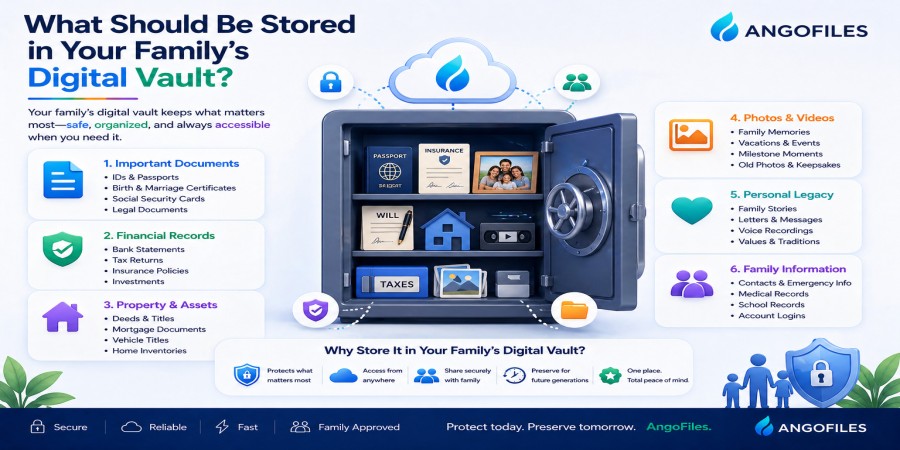
What Should Be Stored in Your Family’s Digital Vault?
Apr 28, 2026 01:58 PM
Leandro Neto
What Should Be Stored in Your Family’s Digital Vault?
A family’s digital vault is more than a folder or a cloud account. It is a secure place where the most important records, memories, and documents of the household are kept together in an organized and protected way. When life becomes busy, documents tend to scatter across phones, email inboxes, drawers, notebooks, and old storage devices. That usually works until something is urgently needed.
A digital vault solves that problem by creating one trusted place for the files that matter most. It is not meant for random downloads or everyday clutter. It is meant for items that would be difficult, expensive, or impossible to replace if they were lost.
The key question is not whether a family should have a digital vault. The real question is what should go into it.
Why a Family Digital Vault Matters
Every family deals with important information. Some of it is legal. Some of it is financial. Some of it is personal. Some of it is emotional. Much of it is easy to forget until the exact moment it becomes necessary.
A digital vault helps because it creates order. Instead of searching through old emails or asking different family members where a document is kept, everything is stored in one secure place. That saves time, reduces stress, and makes it easier to respond quickly when something important happens.
A well-built vault also helps with continuity. If one device is lost, damaged, or replaced, the family still has access to the documents that keep daily life running. In that sense, the vault is not just storage. It is protection.
1. Identity Documents
One of the most important things to store in a family digital vault is identity documentation. These are the documents that prove who each family member is and are often needed for travel, school, banking, healthcare, or legal matters.
Examples include birth certificates, passports, national ID cards, residency documents, and in some cases marriage certificates or school registration records. These documents should be stored as clear, readable scans or photos, with each file labeled properly by person and type.
If an original is lost, a digital copy can make recovery much easier. Even when physical copies are still safe, keeping digital versions in the vault adds an important layer of security.
2. Medical Records and Health Information
Families often need quick access to health-related documents. This can include vaccination records, prescription information, allergy details, hospital discharge papers, insurance details, and emergency contact information.
Medical documents are especially useful in urgent situations because they help doctors, schools, or caregivers respond faster. A family vault keeps that information available without needing to search through old paper files or rely on memory.
These records should be kept private and protected because they contain sensitive information. A digital vault is ideal for this because it can be organized securely while still being accessible when needed.
3. Financial Records
Financial documents are another essential part of a family vault. These files help track responsibilities, prove payments, and support important decisions.
Useful financial files include bank account summaries, insurance policies, receipts for major purchases, tax documents, loan records, utility agreements, and proof of ownership for valuable items. If a family runs a small business from home, some business-related financial records may also belong in the vault.
These documents are not only useful for emergencies. They are also helpful for planning, budgeting, and long-term organization. When financial records are stored properly, the family has more control and less confusion.
4. Property and Home Documents
Any family that owns or rents property should keep important home documents in the vault. These can include property deeds, lease agreements, house plans, maintenance records, warranties, renovation documents, and utility contracts.
These files are important because they prove responsibility, support legal claims, and help with future decisions about the home. If repairs, insurance claims, or ownership questions ever arise, having these documents ready can save a great deal of time.
A digital vault makes these records easier to preserve and easier to find when needed.
5. Insurance Documents
Insurance papers are often forgotten until there is a problem. That is why they belong in the family vault.
This includes health insurance, life insurance, car insurance, home insurance, and any other policy documents the family relies on. It is also useful to store policy numbers, renewal dates, and contact details for the insurance provider.
If something unexpected happens, having these documents already organized can make the process much smoother. It reduces delays and helps the family act quickly.
6. School and Education Documents
For families with children or students, education records are extremely useful to store. These may include report cards, admission letters, school IDs, transcripts, certificates, awards, fee receipts, and assignment-related records that need to be preserved.
A digital vault keeps these records safe over the years instead of letting them disappear in piles of paper or old school bags. It also helps parents or guardians access them quickly when moving schools, applying for programs, or handling administrative issues.
Education records are part of a child’s history, and they often become more valuable over time.
7. Legal Documents
Some documents are too important to leave scattered in random places. Legal records should always be stored securely in the family vault.
This category can include wills, power of attorney documents, custody papers, court records, agreements, contracts, and any signed legal file that affects the family. These are often documents that people only need in serious situations, but when that moment comes, access matters a lot.
Keeping them in one protected location reduces confusion and helps avoid delays when decisions must be made quickly.
8. Emergency Contact Information
A family vault should also contain practical emergency information. This can include phone numbers for relatives, doctors, schools, neighbors, landlords, lawyers, and trusted family friends. It can also include instructions for what to do in a medical, travel, or family emergency.
This type of information may seem simple, but it becomes incredibly useful during stressful moments. When people are calm, they know their contacts. When they are under pressure, they often forget.
A digital vault ensures that important contact information is easy to retrieve when it matters most.
9. Password and Account Recovery Information
Families often use multiple shared or important online accounts. These may include cloud storage, streaming platforms, school portals, banking apps, or utility accounts. Recovery details for these accounts are useful to store, but they should be handled with great care.
The best practice is to keep this information inside a password manager or an encrypted, highly protected part of the vault, not in plain text files. That helps protect access while still making recovery possible if needed.
This category should be treated with extra caution because it can unlock sensitive parts of family life.
10. Photos, Videos, and Family Memories
A family vault is not only for formal documents. It can also preserve important memories. Photos and videos of birthdays, weddings, trips, anniversaries, graduations, and everyday family moments often become some of the most meaningful files in the vault.
These files are emotionally valuable because they capture moments that cannot be recreated. A family archive inside the digital vault helps protect those memories from loss and keeps them easy to revisit later.
This part of the vault often becomes one of the most cherished over time.
11. Travel Documents
Families that travel should keep travel-related files in the vault as well. That can include flight tickets, hotel confirmations, visa copies, travel insurance, itinerary details, and booking receipts.
When a trip is approaching or an unexpected issue appears, having everything in one place makes life easier. A digital vault helps the family stay prepared without needing to search across email threads or messaging apps.
Travel files are especially useful because they often matter only at specific moments, but those moments can be stressful if the documents are missing.
12. Important Household Records
A family vault should also include practical household documents. These may include appliance warranties, service records, repair invoices, manual PDFs, vehicle documents, maintenance schedules, and purchase receipts for valuable household items.
These files are easy to ignore until something breaks. Then they become very important. A clean digital vault prevents that problem and helps the family manage the home more efficiently.
What Should Not Be Stored Carelessly
A family digital vault should be secure, not overloaded. Not everything belongs there in the same way. Random entertainment files, temporary downloads, and unimportant duplicates do not need to take up space in the vault.
The vault should stay focused on files that are meaningful, important, or difficult to replace. That keeps it useful and easier to manage.
It is also important not to store sensitive information in a weak or unprotected system. A digital vault only works if access is controlled properly. Security and organization must go together.
How to Organize a Family Digital Vault
A good vault should be simple to understand. One practical structure may look like this:
Family Vault
- Identity Documents
- Medical Records
- Financial Records
- Property Documents
- Insurance
- School Records
- Legal Documents
- Travel Files
- Emergency Contacts
- Photos and Videos
Inside each category, files can be grouped by person, date, or event. The more consistent the structure is, the easier the vault becomes to use over time.
The goal is not to make the vault complicated. The goal is to make it reliable.
Why a Digital Vault Becomes More Valuable Over Time
At first, a vault may feel like a simple storage system. Over time, it becomes much more than that. It turns into the family’s memory, record book, and emergency support system all in one.
As the family grows, moves, travels, and changes, the vault keeps important information in one stable place. That kind of continuity becomes more valuable with each passing year.
A family digital vault is not just for today. It is for the future.
Conclusion
A family digital vault should store the documents and files that are most important, most sensitive, or most difficult to replace. That includes identity documents, medical records, financial files, property papers, insurance documents, school records, legal files, emergency contacts, travel information, household records, and meaningful family photos and videos.
When these files are organized well and stored securely, the family gains peace of mind, faster access, and much better control over important information.
A digital vault is not about storing everything. It is about protecting what matters most.
Protect Your Family Files with AngoFiles
With AngoFiles, you can store and organize your family’s most important files in one secure place. Keep your documents accessible, protected, and easy to manage when life gets busy.
Start using AngoFiles today and build a digital vault your family can trust.
Login or create account to leave comments
Popular articles
Optimizing Digital Work: How Cloud Storage, File Sharing, an...
Dec 14, 2025 04:08 PM

Upload and Share Your Files with Ango Files
Dec 14, 2025 03:45 PM
Best Secure Cloud Storage for Business in 2026
Jan 17, 2026 11:19 AM
Best Free Cloud Storage Services in 2026
Apr 03, 2026 07:01 AM

How to Send Large Files Over the Internet for Free (Complete...
Mar 30, 2026 05:19 PM
Categories
Comments (0)