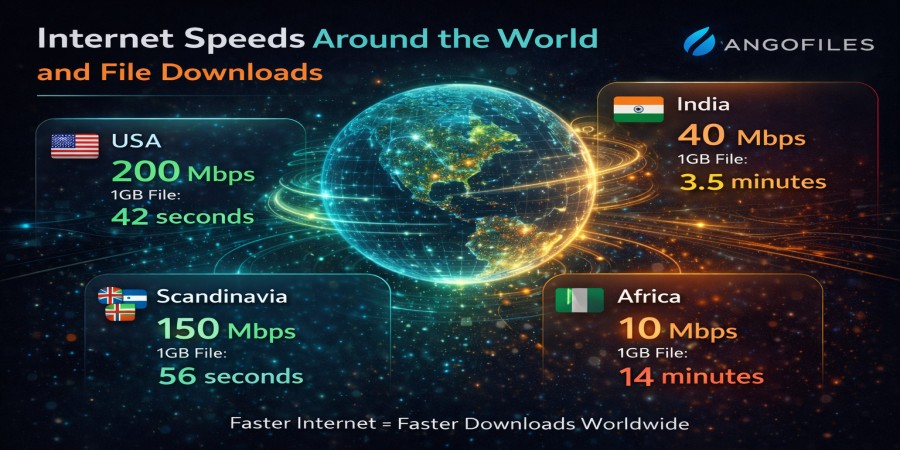
Internet Speeds Around the World and File Downloads
Apr 20, 2026 05:36 AM
Leandro Neto
Internet Speeds Around the World and File Downloads
Internet speed is one of the biggest factors shaping how people experience file downloads, but it is also one of the most uneven parts of digital life. The world is more connected than ever, yet access quality still varies sharply by location, income, infrastructure, and device access. The ITU says that by 2025 almost three-quarters of the world’s population are online, but 2.2 billion people remain offline, and the digital divide is increasingly defined by speed, reliability, affordability, and skills.
That matters because file downloads are not just about “having internet.” They depend on how fast the connection is, how stable it feels, how far the user is from the server, and whether the platform is built to handle different network conditions. A download can feel instant in one country and painfully slow in another, even when the file is exactly the same.
Why Internet Speed Is Not the Same Everywhere
A global file-sharing strategy cannot assume that every user has the same network quality. The ITU’s 2025 reporting shows that mobile broadband coverage is nearly universal, but quality and affordability gaps remain, and 5G access is still highly unequal across income groups and regions. In the same report, 5G coverage is estimated at 55% of the world population, but 84% in high-income countries versus only 4% in low-income countries.
That means the same file may be downloaded on a fast fixed connection in one market, on a variable mobile connection in another, and on a constrained low-bandwidth network somewhere else. For a user, the difference is not theoretical. It determines whether the file opens quickly, whether the download completes, and whether they come back to use the platform again.
What Slows File Downloads Down
File download performance is shaped by more than raw speed. Latency matters because it is the time it takes for data to move from one point on a network to another, and it directly affects how quickly a request begins to load. Cloudflare notes that latency is a time measurement, not a data-volume measurement, and that lower latency is an important part of a good user experience.
In practical terms, a user may have “good internet” on paper but still experience slow file access because the request has to travel a long distance, the server is overloaded, or the content is being served inefficiently. This is why performance can vary so much from one region to another, even for the same platform.
Why the Same File Feels Faster in Some Countries
The experience of downloading a file depends heavily on where the file is delivered from. Cloudflare explains that a CDN is a geographically distributed group of servers that caches content close to end users, and that this reduces load times by shortening the distance the data must travel. It also states that CDNs can improve content availability, reduce bandwidth costs, and withstand traffic spikes and hardware failure better than many origin-only setups.
That means a user near a cached copy of a file may start the download almost immediately, while another user far from the origin server may experience delays before the transfer even begins. In file sharing, geography becomes performance.
Why This Matters So Much for Downloads
When users are waiting for a file, every second matters. Slow downloads increase frustration, and frustration increases abandonment. Cloudflare explicitly notes that users begin to leave as wait times increase, which is why reducing distance and latency improves both user experience and time on page.
For file sharing platforms, that has a direct business effect. Faster downloads mean fewer drop-offs, better completion rates, stronger trust, and more repeat usage. Slower downloads do the opposite: they reduce confidence, lower engagement, and push users toward other options. This is especially important when users are on mobile connections or in regions where speed and affordability are still major barriers.
File Size, Network Conditions, and User Behavior
Internet speed also changes how people behave around file size. A large file can feel normal on a fast connection and unreasonable on a slower one. That is why the same upload can perform well in one market and poorly in another. The problem is not only speed; it is also patience, data cost, and stability. The ITU’s 2025 findings make clear that affordability and quality remain part of the connectivity gap, not just basic access.
This is where smart file delivery matters. If your platform assumes every user can handle large downloads instantly, you will lose a significant share of your audience. A better approach is to design for mixed conditions: optimize file size, keep delivery fast, and reduce unnecessary friction. That is not just technical hygiene; it is audience strategy.
The Business Case for Faster Delivery
Internet speed is not only a user-experience issue. It is a conversion issue. The better the download experience, the more likely users are to complete the action, return later, and trust the platform again. Cloudflare’s CDN documentation emphasizes that faster loading improves user retention and can reduce bounce behavior, while distributed delivery also improves availability and resilience.
For a file-sharing business, that means performance is revenue protection. Slow links waste demand. Fast, reliable links turn attention into completed downloads. In a competitive market, that difference is decisive.
What a Global File Strategy Should Do
A platform that serves users worldwide has to account for unequal internet conditions. The most effective strategy is to reduce friction at every point: shorten delivery distance, improve latency, support mobile users, and make file access as simple as possible. Cloudflare’s CDN model is built around exactly that idea: place content closer to users, reduce round-trip time, and serve files from nearby edge locations.
That approach is especially important now that digital connectivity is widespread but uneven. With about 6 billion people online and billions still facing gaps in quality or access, a file-sharing platform that performs well only in rich or high-speed markets is leaving most of the world behind.
Conclusion
Internet speeds around the world shape file downloads in a very real way. Some users enjoy fast, smooth access because they are close to strong infrastructure and distributed content. Others face delays, interruptions, and larger barriers because their networks are slower, less stable, or more expensive. The global internet may be massive, but the experience is still unequal.
That is why file sharing platforms need more than storage. They need delivery systems that respect how the world actually connects. Speed, latency, and accessibility are not side details. They are the foundation of user trust and download success.
Start Delivering Files Better with AngoFiles
With AngoFiles, you can upload, organize, and share files through a system designed to make access easier and more reliable for users in different network conditions. If your audience is global, your delivery strategy should be global too.
Login or create account to leave comments
Popular articles
Optimizing Digital Work: How Cloud Storage, File Sharing, an...
Dec 14, 2025 04:08 PM
Upload and Share Your Files with Ango Files
Dec 14, 2025 03:45 PM

Best Secure Cloud Storage for Business in 2026
Jan 17, 2026 11:19 AM

Best Free Cloud Storage Services in 2026
Apr 03, 2026 07:01 AM

How to Send Large Files Over the Internet for Free (Complete...
Mar 30, 2026 05:19 PM
Categories
Comments (0)