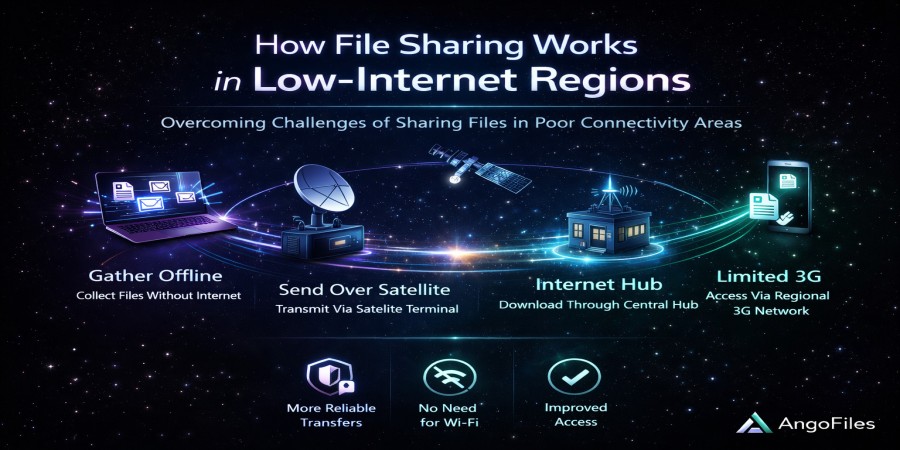
How File Sharing Works in Low-Internet Regions
Apr 20, 2026 05:43 AM
Leandro Neto
How File Sharing Works in Low-Internet Regions
File sharing in low-internet regions works differently from file sharing in high-connectivity markets. The core challenge is not whether people need files, but whether they can access them quickly, affordably, and reliably. The ITU’s 2025 facts show that internet access is still deeply uneven: about 6.0 billion people are online, 2.2 billion remain offline, and only 23% of people in low-income countries use the internet compared with 94% in high-income countries.
That gap changes the entire logic of file delivery. In low-internet regions, the best file-sharing systems are not the ones that assume constant speed. They are the ones that reduce friction, tolerate interruptions, and give people multiple ways to get a file even when the connection is weak or unstable.
Why low-internet regions need a different file-sharing model
A file-sharing system built for fast, stable broadband can fail badly on slower networks. In lower-connectivity environments, users may be on mobile data, may face limited bandwidth, or may have to deal with connections that drop during a transfer. The ITU says the global digital divide is now shaped not only by access, but also by quality, affordability, and skills.
That means file sharing has to be designed around resilience. If a user cannot keep a connection open for long, the system must avoid restarting everything from scratch. If a user has limited data, the system must reduce file size and unnecessary overhead. If a user is far from the server, the system must shorten the distance the file has to travel.
The role of resumable transfers
One of the most important techniques in low-bandwidth environments is resumable transfer. Google Cloud explains that resumable uploads let a transfer continue after a communication failure interrupts it, instead of forcing the upload to restart from zero.
For users in low-internet regions, this is essential. A small outage, a weak signal, or a dropped mobile connection should not waste the entire transfer. Resumable systems protect the user’s time, reduce data waste, and make large files much more practical to move over unstable networks. The same logic applies to downloads when systems support partial transfer and recovery.
Why partial downloads matter
HTTP range requests let a server send only part of a file to a client. MDN notes that range requests are useful for download managers that let users pause and resume a download, as well as for large files and media access.
This matters in low-internet regions because downloads often fail before they finish. Partial requests make the experience more forgiving. Instead of losing progress, the user can continue from where the connection stopped. That is a much better match for real-world network conditions than a single, fragile full-file transfer.
Why smaller, closer, and simpler wins
In low-internet regions, successful file sharing usually depends on three things: smaller files, shorter delivery distance, and simpler workflows. CDNs help with the second part by placing servers closer to users. Cloudflare describes a CDN as a network of servers designed to deliver content more quickly, cheaply, reliably, and securely, while also reducing the distance data has to travel.
That is important because long-distance delivery increases latency, and latency affects how quickly a request begins. Cloudflare defines latency as the time it takes for data to move across the network, which means even a file that is not very large can feel slow if the round trip is inefficient.
Offline-first design changes everything
In low-connectivity environments, the best apps and platforms often use offline-first thinking. Android’s official documentation defines an offline-first app as one that can perform all or a critical subset of its core functionality without internet access.
For file sharing, that means users can prepare uploads, save content locally, queue actions, and sync later when the connection returns. This approach is much more realistic than demanding a perfect connection at every step. It also helps users move content during short windows of connectivity instead of forcing them to stay online for the entire transfer.
Local sharing still has a major role
In very low-connectivity contexts, not every transfer needs the internet. Android’s Quick Share page says users can transfer photos, videos, documents, audio files, or folders between devices nearby. That kind of local transfer is valuable where internet access is expensive, slow, or unavailable.
Local sharing does not replace cloud storage, but it complements it. A user can move a file between nearby devices instantly, then upload it to the cloud later when connectivity improves. This hybrid model is especially useful when the goal is access first and sync second.
What users actually experience
For the user, file sharing in low-internet regions is usually a story of trade-offs. They may accept slower downloads if the file is important. They may prefer smaller formats if data is costly. They may trust a platform more if it resumes after interruption. They may choose local transfer over cloud delivery when the connection is unreliable. These behaviors follow directly from the constraints the ITU identifies: gaps in access, quality, affordability, and skills.
That is why a “global” file-sharing strategy must be built for uneven conditions. A system that works only for high-speed broadband users is not truly global. It is only selective.
What a better file-sharing platform should do
A strong platform for low-internet regions should support resumable uploads, partial downloads, nearby transfer options, and low-friction access. It should also use infrastructure that brings files closer to users when possible, because distance still matters for speed and reliability. These design choices are not optional extras; they are what make file sharing usable in real-world conditions.
The best systems are the ones that work when the connection is good, but still remain usable when the connection is bad. That is the difference between a platform that looks modern and a platform that actually serves everyone.
Conclusion
File sharing in low-internet regions works through adaptation. It depends on resumable transfers, partial downloads, offline-first design, local sharing, and delivery systems that reduce distance and delay. The goal is not to force weak networks to behave like strong ones. The goal is to make file access useful under real conditions.
As the ITU’s 2025 data shows, digital access remains uneven across the world, so file-sharing platforms that ignore network reality will keep losing users. The platforms that win will be the ones that treat reliability, simplicity, and resilience as core features, not bonuses.
Start building for real-world connectivity with AngoFiles
With AngoFiles, you can share files in a way that respects slow networks, unstable connections, and different user conditions. A platform built for accessibility is a platform built for growth.
Login or create account to leave comments
Popular articles
Optimizing Digital Work: How Cloud Storage, File Sharing, an...
Dec 14, 2025 04:08 PM
Upload and Share Your Files with Ango Files
Dec 14, 2025 03:45 PM

Best Secure Cloud Storage for Business in 2026
Jan 17, 2026 11:19 AM

Best Free Cloud Storage Services in 2026
Apr 03, 2026 07:01 AM

How to Send Large Files Over the Internet for Free (Complete...
Mar 30, 2026 05:19 PM
Categories
Comments (0)