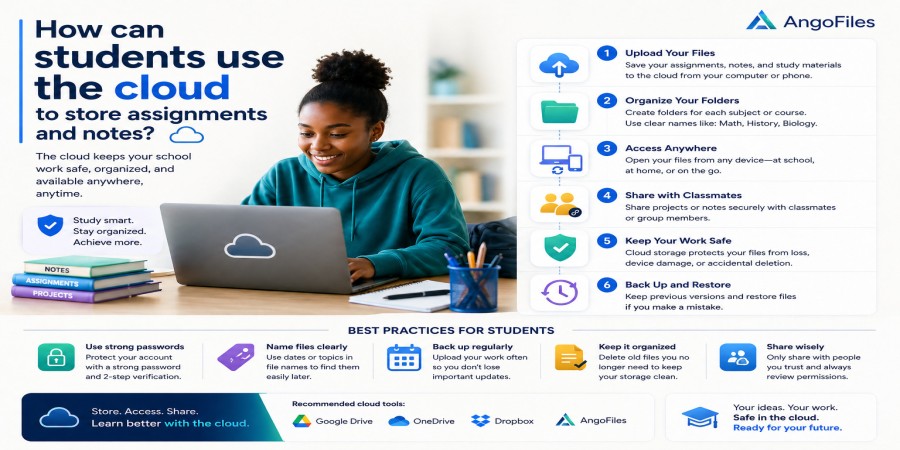
How can students use the cloud to store assignments and notes?
Apr 25, 2026 03:29 PM
Leandro Neto
How Students Can Use the Cloud to Store Assignments and Notes
Students handle a constant flow of files. There are class notes, assignment drafts, research materials, scanned documents, study guides, presentations, and final submissions. When all of that is stored in random folders, on different devices, or in messaging apps, it becomes easy to lose track of what matters.
Cloud storage gives students a much better system. It creates one reliable place to store assignments and notes, access them from anywhere, and keep schoolwork organized over time. That is not just convenient. It saves time, reduces stress, and makes studying more efficient.
For students, the cloud is more than a storage space. It is a study tool.
Why Cloud Storage Helps Students
The biggest challenge for students is not always creating work. It is managing it. Many students lose time searching for files, sending documents to themselves, or trying to remember which version is the latest one. A cloud system solves those problems by putting everything in one place.
With cloud storage, students can:
- access notes from phone, laptop, or tablet
- keep assignments backed up automatically
- share files easily with classmates or teachers
- avoid losing work if a device is damaged
- stay organized across different subjects and semesters
That means less confusion and more time for actual studying.
1. Store Assignments in One Central Place
Assignments should never be scattered across different devices or chat apps. If one essay is on the laptop, another is in email, and a presentation is in the phone downloads folder, things become messy very quickly.
A cloud folder for assignments keeps everything together. Students can create folders by subject, class, or semester and save each task in the right place. That makes it easier to find old work later, submit the right file, or review past assignments before exams.
A simple structure can look like this:
- School
- Mathematics
- English
- History
- Science
- Submissions
This kind of organization makes schoolwork much easier to control.
2. Keep Notes Safe and Accessible
Notes are one of the most valuable study resources a student can have. They often contain summaries, explanations, examples, and key points that are important for revision. If those notes are only saved on paper or on one device, they can be lost or damaged.
Cloud storage protects notes by keeping digital copies safe online. Students can type notes directly into documents, scan handwritten notes, or upload photos of notebook pages. That way, study materials stay available even if the original paper notebook is lost.
This is especially useful when preparing for exams, because students can review their notes from anywhere instead of carrying everything physically.
3. Avoid Losing Work
One of the most frustrating experiences for any student is losing an assignment after hours of work. A computer crash, accidental deletion, or damaged phone can wipe out important progress in seconds.
Cloud storage reduces that risk. When assignments and notes are stored online, they are backed up and protected from local device problems. That means students can recover files quickly and continue working without starting over.
This protection is especially important for large projects, research papers, and final-year work that cannot easily be recreated.
4. Access Files From Anywhere
Students do not always study in one place. Sometimes they are at home, sometimes at school, sometimes in a library, and sometimes using a shared device. Cloud storage makes it possible to open the same file wherever they are.
That flexibility makes studying much easier. A student can revise on the bus, continue a draft at school, or check a note on a phone while away from a laptop. The cloud removes the need to depend on one device at one location.
This is one of the most practical advantages of cloud storage for students. It fits the way students actually live and study.
5. Share Work Easily With Classmates
Students often work in groups or need to send files to classmates. Cloud storage makes that process much easier.
Instead of sending the same file repeatedly through messaging apps, students can upload the document once and share a link. That saves time and avoids confusion. Everyone can view the same file, and updates are easier to track.
This is especially useful for:
- group projects
- shared study notes
- research materials
- presentations
- class resources
A shared cloud folder can become a simple and efficient way for students to collaborate.
6. Keep Different Subjects Separate
A major reason students lose control of their files is that everything gets mixed together. Notes, assignments, PDFs, screenshots, and random downloads all end up in the same place. That makes finding the right file much harder.
A better habit is to separate files by subject. For example:
- Mathematics
- English
- Biology
- History
- Computer Studies
Inside each subject folder, students can create smaller folders for notes, assignments, and revision materials. This structure makes the cloud easier to use and keeps schoolwork from becoming chaotic.
When files are separated properly, students can study faster and work more confidently.
7. Use the Cloud for Revision Materials
The cloud is not only for storing what students already completed. It is also useful for revision materials.
Students can upload:
- past papers
- study guides
- summarized notes
- slides
- scanned exercises
- sample answers
Keeping revision materials in the cloud means they are always available when exam season comes. Instead of searching through piles of paper or old folders, students can go directly to one place and start reviewing.
That makes preparation much more efficient.
8. Make Group Work Less Stressful
Group assignments often become complicated because files move through too many people and too many versions. One student has the draft, another has the corrected version, and someone else has the final file in the wrong chat.
Cloud storage makes group work much smoother. A shared folder or shared document keeps everything in one place. Everyone knows where the latest version is, and no one has to ask for the file again and again.
This reduces mistakes and helps the group stay organized. For students, that means less stress and better teamwork.
9. Build Good Study Habits
Cloud storage can also help students build discipline. When they get used to saving files in the right place, naming them clearly, and backing them up regularly, they naturally become more organized.
Good digital habits often lead to better study habits. A student who keeps files clean and accessible is more likely to stay on top of deadlines and revision. The cloud creates a structure that encourages responsibility and consistency.
That is important because school success is often affected by small habits repeated over time.
10. Prepare for University and the Future
Learning how to manage files is a useful skill beyond school. In university and in work life, people handle large amounts of digital information all the time. Students who already know how to use cloud storage well will have an easier time managing that responsibility later.
That means cloud storage is not only helping with today’s assignments. It is also teaching students how to stay organized in the future.
The earlier students learn this habit, the more useful it becomes.
A Simple Cloud System for Students
A practical student cloud system can be very simple:
- Main folder for school
- One folder per subject
- Separate folders for assignments, notes, and revision
- Clear file names
- Regular backup of important work
For example:
School
- Mathematics
- Notes
- Assignments
- Revision
- English
- Notes
- Assignments
- Revision
- Science
- Notes
- Assignments
- Revision
This kind of structure is easy to understand and easy to maintain.
Conclusion
Students can use the cloud to store assignments and notes in a way that is safer, faster, and more organized than keeping everything on one device. It helps them avoid losing work, access files from anywhere, share with classmates, and keep study materials ready for revision.
The cloud is not just a place to store school files. It is a practical support system that helps students study better and stay more organized.
Study Smarter with AngoFiles
With AngoFiles, students can store assignments, notes, and revision materials in one reliable place. Keep your school files organized, access them from anywhere, and make studying easier every day.
Start using AngoFiles today and build a smarter way to manage your academic life.
Login or create account to leave comments
Popular articles

Optimizing Digital Work: How Cloud Storage, File Sharing, an...
Dec 14, 2025 04:08 PM

Upload and Share Your Files with Ango Files
Dec 14, 2025 03:45 PM

Best Secure Cloud Storage for Business in 2026
Jan 17, 2026 11:19 AM

Best Free Cloud Storage Services in 2026
Apr 03, 2026 07:01 AM

How to Send Large Files Over the Internet for Free (Complete...
Mar 30, 2026 05:19 PM
Categories
Comments (0)