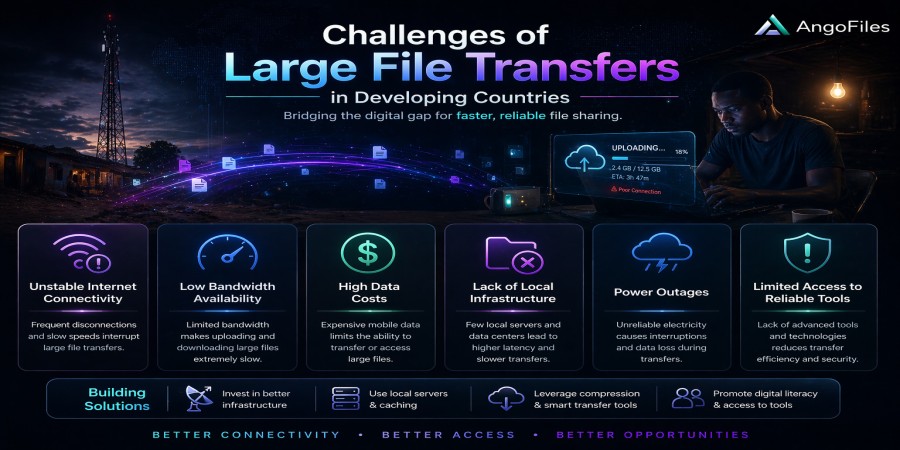
Challenges of Large File Transfers in Developing Countries
Apr 21, 2026 05:57 PM
Leandro Neto
Challenges of Large File Transfers in Developing Countries
Large file transfers are one of the most underestimated problems in digital access. On paper, sending a file is simple: upload, share, download. In reality, that process becomes difficult when the network is slow, unstable, expensive, or shared across multiple users and devices. The ITU’s 2025 data shows that broadband access is still shaped by large quality and affordability gaps, and that coverage alone does not guarantee usable connectivity. Mobile broadband is nearly universal in coverage, but services remain out of reach for many people, especially in lower-income economies.
This is why large file transfers in developing countries are not just a technical issue. They are a connectivity issue, an affordability issue, and often a usability issue. To understand the problem properly, you have to look at how real people connect, how much they can afford to spend on data, and what happens when a transfer is interrupted halfway through.
1. The internet may be available, but not always usable
One of the biggest misconceptions about developing countries is that “internet access” means the same thing everywhere. It does not. The GSMA defines meaningful connectivity as a safe, satisfying, enriching, and productive online experience that is affordable in the user’s context, and says that meaningful connectivity depends on affordability, knowledge, skills, safety, security, and relevant services.
That definition matters because a large file transfer needs more than basic signal bars. If the connection is unstable, the file may fail repeatedly. If the user has limited data, large downloads become expensive. If the network is slow, the file may take so long that the user gives up. In other words, the barrier is not simply whether a person is online. The barrier is whether the network can sustain a large transfer from start to finish.
2. Data cost turns large files into a luxury
Affordability is one of the most important reasons large transfers fail. The ITU reports that in 2025 the median price of a 5 GB mobile broadband basket is 1.4% of GNI per capita globally, but that affordability remains a major barrier in low-income economies. The same report says subscribers in lower-middle-income economies spend about seven times as much of their income on mobile broadband as those in high-income economies, while subscribers in low-income economies spend about 22 times more. In low-income countries, a fixed broadband subscription can cost more than one quarter of the average income.
When data is expensive, users ration it. They avoid unnecessary downloads, postpone large transfers, and prefer compressed or lightweight files. That means large files do not fail only because of technical limits; they fail because the economics of the connection discourage completion. A 500 MB file may be normal in a high-income market, but in a low-income market it can represent a serious portion of someone’s available data budget.
3. Slow and unstable networks break transfers
Large files are especially vulnerable to interruptions. Google Cloud’s documentation says resumable uploads are the recommended method for uploading large files because they do not need to restart from the beginning if a network failure occurs, and they are also recommended when uploading over a slow connection. Google explains that resumable uploads work by sending multiple requests, each containing part of the file, so a failure does not destroy the entire transfer.
That matters in developing countries because many users rely on mobile networks, and mobile networks are more likely to fluctuate than wired broadband. If a connection drops halfway through a transfer and the system is not resumable, the user loses time, data, and trust. For large files, this is often the difference between a successful delivery and a complete failure.
4. Distance to the server makes everything worse
Even when a user has enough data and enough patience, distance still matters. Cloudflare explains that a CDN improves latency by caching files in distributed locations and serving them from the closest edge server, reducing the physical distance data must travel. Cloudflare also notes that CDN edge servers reduce load times by bringing content closer to the user, and can improve reliability when traffic spikes or one server goes down.
In developing countries, this is especially important because many users are far from the major infrastructure hubs where large platforms often host their origin servers. Without edge delivery or caching, every request has to travel farther, which adds latency and makes large transfers feel slower and less dependable. The file may be healthy, but the path to it is not.
5. Mobile-first use creates practical limits
The reality in many developing countries is that mobile internet is the primary way people connect. That changes how file transfers behave. Phones have more limited storage than desktops, users may switch between networks, and background transfers can stop when apps are closed or power-saving settings activate. The GSMA’s 2025 reporting emphasizes that meaningful connectivity is not just access, but productive use in context, which includes the practical realities of device ownership and online behavior.
Large file sharing systems that ignore mobile behavior tend to frustrate users. They assume long uninterrupted sessions, stable power, and constant signal. In practice, users in developing countries often need systems that allow pausing, resuming, lighter file versions, and low-friction mobile access.
6. Infrastructure gaps make the problem structural
The challenge is not only personal connection quality. It is also infrastructure. ITU and GSMA reporting both show that quality, affordability, and rural-urban gaps remain major barriers. That means a person in one city may be able to download a large archive quickly, while another user in a rural area or lower-income setting struggles with the exact same file.
This is why large file transfer is a structural problem. You cannot solve it only by asking users to be patient or by telling them to “try again later.” The system itself has to be built for interruption, delay, and inconsistency.
7. The user experience breaks before the file finishes
A large transfer is not just a technical event. It is also a trust event. When a user sees a file that is too big for their connection, they immediately evaluate whether it is worth the time and data. If the transfer is slow, they may assume the platform is unreliable. If it fails once, they may not come back. Cloudflare’s performance guidance explains that reducing latency and serving content from closer locations improves the user experience, which is exactly why poor delivery has such a strong negative effect.
In that sense, the download experience becomes part of the product. A large file that is theoretically useful may still fail commercially or operationally if users cannot complete the transfer. For platforms, that means performance is not a bonus feature. It is the difference between usage and abandonment.
8. What works better in developing countries
The most effective large-file strategy is to reduce friction at every stage. Google Cloud recommends resumable uploads for large files and slow connections. Cloudflare recommends CDN-based delivery to reduce latency and improve reliability. Android’s offline-first guidance shows how software can preserve core functionality without internet access, which is useful when users need to prepare files, queue actions, or sync later. Together, those approaches point to the same principle: the system must tolerate weak connectivity instead of assuming strong connectivity.
For file-sharing platforms, that usually means smaller default files where possible, compressed formats, resumable transfer support, distributed delivery, and mobile-friendly interfaces. For users, it means a better chance of finishing the transfer without wasting data or starting over.
Conclusion
Large file transfers are hard in developing countries because the problem is not just file size. It is the combination of limited affordability, unstable mobile networks, uneven infrastructure, and the absence of transfer systems that are designed for interruption. The ITU’s 2025 data shows that broadband is still uneven in quality and cost, especially in lower-income economies, while the GSMA stresses that meaningful connectivity must be affordable and usable in context.
The takeaway is simple: if a platform wants to serve users in developing countries, it has to build for real-world conditions. Resumable transfers, CDN delivery, offline-friendly workflows, and mobile-first design are not advanced extras. They are the foundation of usable file sharing.
Grow Your File Sharing Platform with AngoFiles
With AngoFiles, you can build a file-sharing experience that respects low-bandwidth conditions, unstable connections, and mobile-first behavior. A platform that is easier to use in difficult network environments has a much better chance of earning trust and repeat use.
Login or create account to leave comments
Popular articles
Optimizing Digital Work: How Cloud Storage, File Sharing, an...
Dec 14, 2025 04:08 PM

Upload and Share Your Files with Ango Files
Dec 14, 2025 03:45 PM

Best Secure Cloud Storage for Business in 2026
Jan 17, 2026 11:19 AM

Best Free Cloud Storage Services in 2026
Apr 03, 2026 07:01 AM

How to Send Large Files Over the Internet for Free (Complete...
Mar 30, 2026 05:19 PM
Categories
Comments (0)