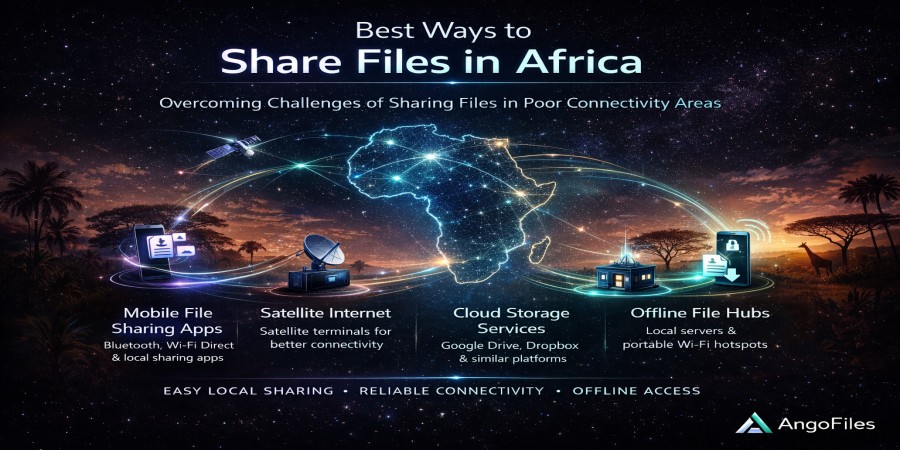
Best Ways to Share Files in Africa
Apr 20, 2026 05:57 AM
Leandro Neto
Best Ways to Share Files in Africa
Sharing files across Africa is not just a question of convenience. It is a question of connectivity, cost, reliability, and access. In 2025, the ITU estimates that internet use in Africa is about 36% of the population, far below the global average, while Sub-Saharan Africa is estimated at 38% compared with 68% globally. The same report also shows deep rural-urban gaps in mobile coverage and fixed infrastructure, which means file-sharing methods that work well in one place may fail in another.
That is why the best file-sharing strategy for Africa is not one single tool. It is a mix of fast delivery, low-friction access, resumable transfers, local sharing options, and offline-friendly workflows that match real network conditions.
1. Use platforms that support resumable transfers
In many African markets, connections can be unstable, expensive, or interrupted by weak signal. A good file-sharing system should not force users to restart from zero every time the network drops. Google Cloud’s resumable upload documentation says resumable uploads allow a transfer to continue after a communication failure interrupts the flow of data. MDN also notes that range requests are useful for download managers that let users pause and resume downloads.
This is one of the most practical ways to improve file sharing in Africa because it protects the user’s time and data. If a transfer fails halfway through, the user should be able to continue instead of starting again. For large files, that difference can determine whether the file gets shared at all.
2. Deliver files through a CDN or edge network
Distance matters. Cloudflare explains that a CDN is a geographically distributed network of servers designed to deliver content faster by reducing the distance data must travel, improving availability and handling traffic more efficiently. In a continent where infrastructure and coverage vary widely, this matters even more.
ITU data shows that in Africa, only 30% of the population lived within 10 km of a fibre node in 2023, and rural 4G coverage was far below urban coverage. That means a platform that serves files from a single distant server will feel slow for many users. A CDN or edge-based delivery setup can significantly improve the experience by bringing files closer to the user.
3. Keep file sizes as small as possible
In low-connectivity environments, file size is not a minor detail. It directly affects whether the file can be downloaded, how much data the user spends, and how likely the transfer is to complete. The ITU notes that Africa is the region with the lowest internet-use penetration and the lowest data consumption, with mobile broadband traffic per subscription far below the global average. That tells you the practical reality: smaller files are easier to deliver and easier to finish.
This is an inference from the connectivity data, but it is a strong one: compress files, avoid unnecessary bloat, and provide lighter versions where possible. For documents, use efficient formats. For media, provide lower-size alternatives when quality does not need to be maximum. A file that downloads successfully is more valuable than a file that is technically better but never finishes.
4. Support local sharing for nearby devices
Not every file has to travel through the internet. Google’s Quick Share documentation says users can transfer photos, videos, documents, audio files, and folders between nearby Android devices and Windows computers, and Google describes Quick Share as a fast, secure way to send files between devices. That is useful in places where internet access is limited or expensive.
Local sharing is especially effective when people are physically close to one another, such as in offices, schools, shops, or community groups. It removes bandwidth from the equation entirely. In regions where mobile data is the main connection and network quality is uneven, local transfer can be the fastest and cheapest option.
5. Build with offline-first thinking
Android’s official documentation defines an offline-first app as one that can perform all or a critical subset of its core functionality without internet access. That principle is highly relevant to file sharing in Africa because connectivity is often intermittent, not constant.
Offline-first design lets users prepare files, queue uploads, save drafts, and sync later when the connection improves. It also reduces the frustration of failed actions. In practical terms, this means your file-sharing experience should keep working during weak signal periods instead of collapsing the moment the network changes.
6. Make download pages fast and simple
A file-sharing page should not waste the user’s connection budget. Clean pages, short load times, and clear download buttons reduce friction and make the process feel trustworthy. Cloudflare notes that latency is the time it takes for data to travel, and that reducing it improves the user experience. In low-bandwidth environments, every extra step adds cost in time and data.
This means you should avoid cluttered layouts, unnecessary redirects, and complicated steps before the file starts downloading. When the connection is weak, simplicity is not just a design preference. It is a performance advantage.
7. Design for mobile first
Africa is overwhelmingly mobile in how many people access the internet, and the ITU and GSMA both emphasize mobile broadband coverage, meaningful connectivity, and the quality of the online experience, not just basic access. GSMA’s 2025 connectivity work also highlights that meaningful connectivity depends on affordability and a satisfying, productive experience in context.
That means file sharing should be mobile-first by default. Buttons must be easy to tap, pages must load cleanly on small screens, and files must be easy to resume when a mobile connection drops. A desktop-only mindset will miss a large part of the audience.
8. Offer multiple sharing paths
The best file-sharing systems in Africa give users more than one way to access the same file. Some users will prefer a direct cloud link. Others will need a resumable transfer. Some will use local sharing on nearby devices. Others will benefit from smaller file versions or offline-ready access. That flexibility matters because the region’s connectivity is uneven across countries, between urban and rural areas, and across different income groups.
A single delivery method is too fragile for a diverse continent. Multiple paths make the system more resilient and more inclusive.
Conclusion
The best way to share files in Africa is to design around reality, not assumptions. Real-world connectivity in the region is shaped by mobile coverage gaps, limited fibre proximity, unequal access between urban and rural areas, and a heavy dependence on mobile networks. ITU data makes that clear.
That is why the strongest approach combines resumable transfers, CDN delivery, smaller files, offline-first workflows, and local sharing options. When file sharing is built for interruption, distance, and mobile use, it becomes usable for far more people.
Grow Your File Sharing Platform with AngoFiles
If you want to share files in a way that fits African users better, AngoFiles can be positioned around speed, simplicity, and reliable access. A platform that respects weak networks and mobile-first behavior has a much better chance of winning trust and repeat use.
Login or create account to leave comments
Popular articles
Optimizing Digital Work: How Cloud Storage, File Sharing, an...
Dec 14, 2025 04:08 PM
Upload and Share Your Files with Ango Files
Dec 14, 2025 03:45 PM

Best Secure Cloud Storage for Business in 2026
Jan 17, 2026 11:19 AM

Best Free Cloud Storage Services in 2026
Apr 03, 2026 07:01 AM

How to Send Large Files Over the Internet for Free (Complete...
Mar 30, 2026 05:19 PM
Categories
Comments (0)